
Members’ Night
Marches, Rivers, Waterfalls, and Streams
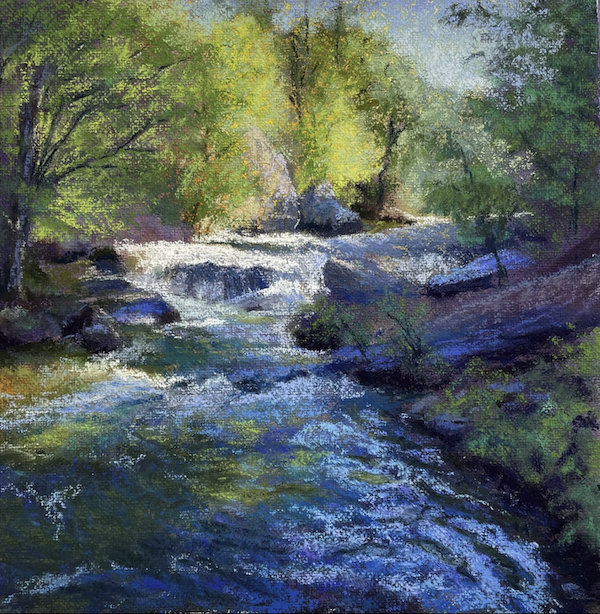
Agua Pura by Mardilan Georgio
We look forward to a lively, instructive evening exploring water and wetland subjects in pastel—techniques to capture motion, reflection, and atmosphere. Bring your work and your questions!
Successful pastel paintings of rivers, waterfalls, and streams depend on careful observation, strong composition, and confident pastel technique. Focus on these key elements:
Composition and design
Establish a clear focal point (a pool, cascade, bend, or reflective surface) and lead the eye with compositional lines—riverbanks, rocks, fallen logs, or the flow direction.
Use foreground, middle ground, and background to create depth. Include elements like stones, vegetation, or reflections to anchor the foreground.
Vary scale and rhythm: combine large shapes (boats, boulders) with smaller repeated elements (ripples, reeds) for visual interest.
Consider the horizon and eye level: a low eye level emphasizes foreground water detail; a higher eye level shows more of the watercourse and landscape.
Value, contrast, and light
Capture the dominant value pattern first. Water scenes rely heavily on contrasts between light (sunlit ripples, highlights) and dark (deep channels, shaded undercuts).
Preserve strong darks to give the water depth; use bright highlights sparingly for sparkle and movement.
Determine the light source and keep highlights and shadow consistent across rocks, vegetation, and water.
Color and temperature
Observe color in water: it often carries reflected colors from sky, banks, and foliage, so mix hues rather than using flat blues.
Use warm colors in sunlit areas and cool colors in shadow to enhance form and depth.
For waterfalls and fast-moving water, whites and cool grays often dominate but carry subtle local color from surroundings.
Keep edges of reflected color softened to suggest surface movement.
Capturing motion and texture
Differentiate water types: smooth, reflective river surfaces; turbulent, broken textures in waterfalls; elongated strokes for flowing streams.
Suggest motion with directional strokes that follow the flow; use short, choppy marks for rapids and long, horizontal strokes for calm stretches.
Use negative painting (leaving paper/pastel underlayers showing) to indicate highlights and spray.
Reflections and transparency
Study how reflections mirror shapes but are softer, darker, and slightly shifted or broken by ripples.
Build reflections by starting with a muted, inverted version of the reflected subject, then soften edges and add ripple marks.
For shallow water, imply transparency by showing submerged rocks and gradations of value/color.
Edges and mark-making
Vary edges to suggest distance and focus: crisp edges in foreground elements, softer edges for distant banks and reflected shapes.
Match pastel marks to texture: broad, blended strokes for smooth water; broken, stippled marks for spray and foam.
Atmosphere and mood
Convey weather and time of day through color temperature and contrast. Morning mist favors desaturated colors and soft edges; midday sun gives strong contrast and vivid colors.
Include environmental cues—mist, spray, wet rocks, glistening leaves—to reinforce wetness.
Technique and materials
Work from reference photos and plein air studies to understand water behavior; combine direct observation with controlled studio work.
Layer pastels: blocked-in underpainting for value structure and luminosity, then progressively refined strokes and highlights.
Preserve a solid drawing and value plan; pastels are additive—plan darks early and reserve the lightest highlights for last.
Use fixative sparingly and only if needed; consider working on sanded or textured paper to hold multiple layers.
Practical tips
Squint to simplify shapes and values before committing detail.
Step back frequently to check overall composition and value relationships.
Test mark types on a scrap of your working surface to choose the best stroke for foam, reflection, or transparent water.
Practice small studies (tonal and color thumbnails) for flow, light, and reflections before a large piece.
By combining careful composition, accurate value structure, thoughtful color relationships, and varied mark-making that follows the water’s movement, you can create convincing and expressive pastel paintings of rivers, waterfalls, and streams.
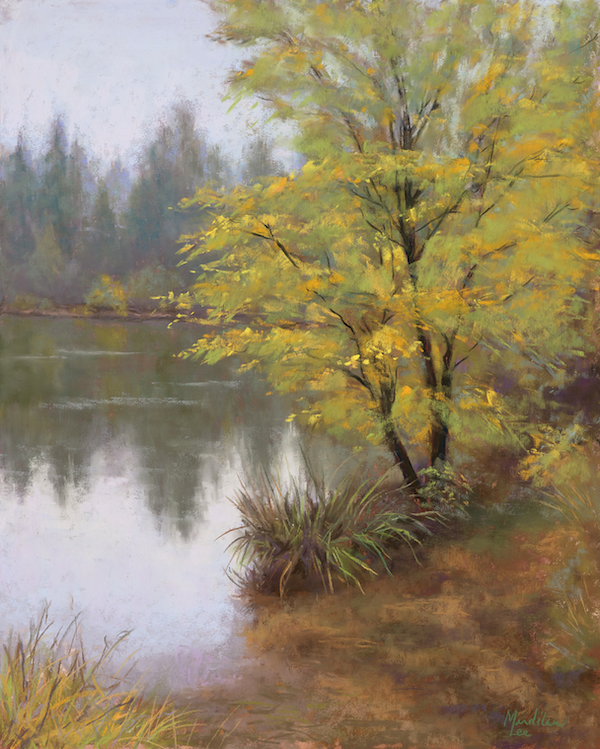
Morning at Manzanita Lake by Mardilyn Georgio